 comparison
ATV vs Tractor for Property Maintenance: Which Is Right?
Table of Contents
- ATV vs Tractor: A Head-to-Head Comparison Table
- ATVs for Property Maintenance: Pros and Cons
- Tractors for Property Maintenance: Pros and Cons
- ATV Attachments for Property Maintenance
- How to Choose a Tractor for Small Acreage
- Maintenance Costs of ATVs vs Tractors
- Which Machine Is Right for Your Property?
- Final Verdict
- Frequently Asked Questions
Last Updated: September 4, 2026
The question of atv vs tractor for property maintenance usually comes down to one thing: how much ground-engaging work do you actually do? If you need to move dirt, grade a driveway, or clear heavy brush with a rotary cutter, a compact tractor wins. If you need to haul tools across rugged terrain, check fence lines, or plow snow on a gravel driveway, an ATV is often the smarter, cheaper tool. This guide from Monarch Honda breaks down the real differences so you can match the machine to your property rather than overbuying.
We have spent 50 years helping property owners in the Orem area outfit their land, and the most common mistake we see is buying for the one big project instead of the weekly routine. Below, we will show you exactly how to weigh towing capacity, attachment versatility, and long-term ownership costs. But first, here is what most guides get wrong: they compare horsepower numbers when the real difference is in the hydraulic system and the three-point hitch.
ATV vs Tractor: A Head-to-Head Comparison Table
| Feature | ATV | Compact Tractor |
|---|---|---|
| Best for | Tight terrain, hauling, snow plowing | Ground engagement, heavy lifting |
| Towing capacity | Moderate (small trailers) | High (implements, loaders) |
| Maneuverability | Excellent in woods and tight spaces | Limited in dense areas |
| Attachment versatility | Light duty (plows, sprayers) | Extensive (3-point hitch, PTO) |
| Storage footprint | Small, fits in a shed | Large, needs dedicated space |
| Operating cost | Lower fuel and maintenance | Higher but more capable |
| Resale value | Strong | Strong, slower depreciation |
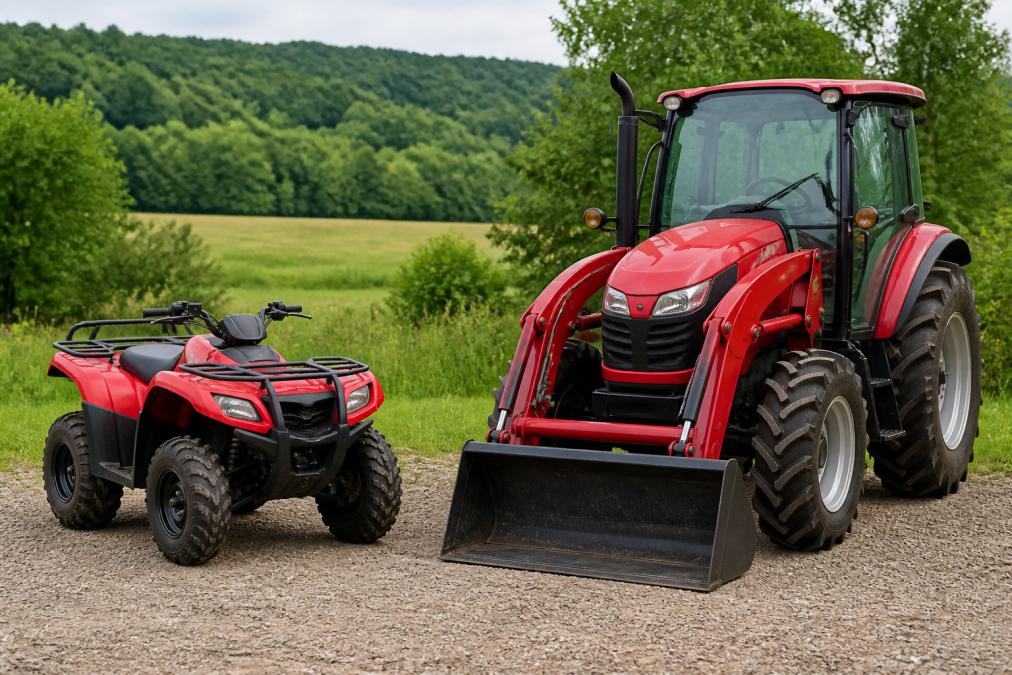
The atv vs tractor decision gets clearer when you map your tasks to this table. An ATV is a utility vehicle for transport and light work. A tractor is a power source for implements that dig, cut, and move material.
ATVs for Property Maintenance: Pros and Cons
ATVs shine on properties under 10 acres where maneuverability matters more than raw power. A model like the Honda Foreman Rubicon, with its independent rear suspension and Electric Power Steering, lets you navigate wooded trails and tight fence lines that would frustrate a tractor operator. Storage is effortless: an ATV fits in a standard shed corner, while a tractor needs its own bay.
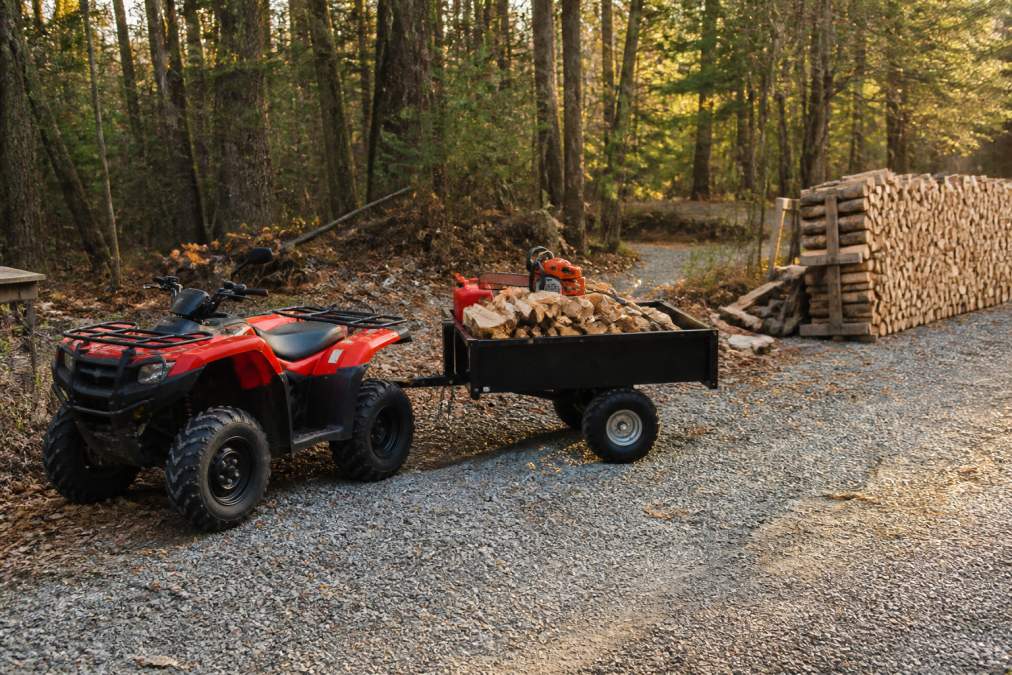
The trade-offs are real. An ATV cannot lift a loaded front-end loader bucket, and its towing capacity tops out well below what a tractor handles. For tasks like brush hogging or tilling, you will find the ground engagement lacking. Many owners also report that hauling heavy loads in an ATV trailer stresses the machine over time.
Tractors for Property Maintenance: Pros and Cons
A compact tractor is the answer when your tasks involve the ground itself. Models like the Yanmar SA Series or John Deere 1 Series bring a Category 1 three-point hitch and a hydraulic system that powers a front-end loader, a flail mower, or a box blade. That implement compatibility transforms the machine from a vehicle into a tool system.
The trade-off is agility and cost. A tractor's longer wheelbase and wider turning radius make it awkward in dense woods, and the operating weight that gives it traction also compacts soil and chews up lawns. Diesel engines offer better fuel efficiency for long work sessions, but they require more maintenance than a gas ATV. You are also committing to a larger storage footprint and a higher purchase price.
ATV Attachments for Property Maintenance
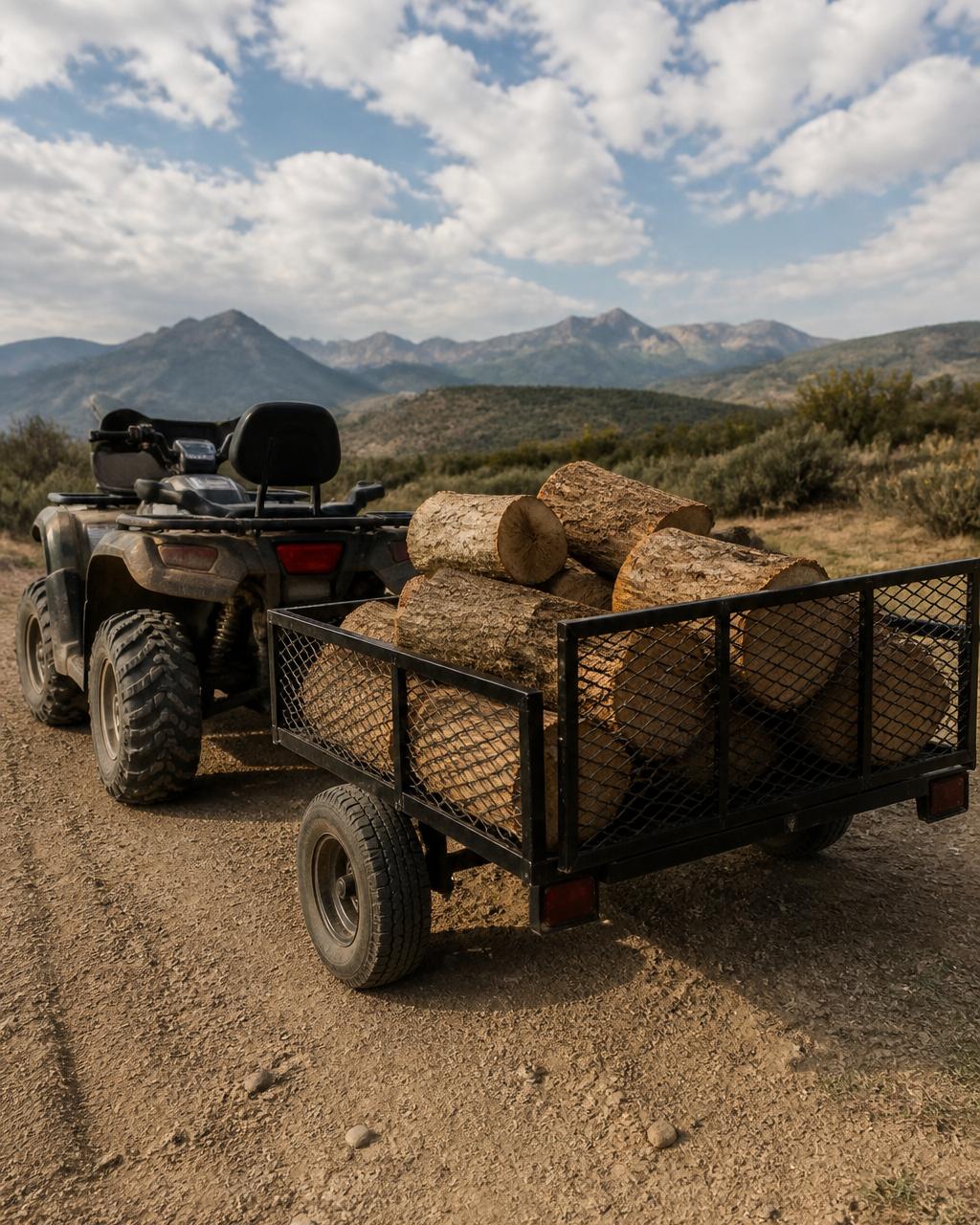
The right attachments can close the gap between an ATV and a tractor for light-duty work. A front-mounted plow handles snow on driveways and paths. A sprayer turns the ATV into a pasture or fence-line treatment tool. Rear racks and small utility trailers expand hauling capacity for firewood, feed, or fencing supplies.
Tractor Safety Resources from the National Institute for Food and Agriculture emphasizes that operators should always match attachment weight to the vehicle's rated towing capacity. Exceeding that rating compromises steering and braking, especially on slopes. For ground engagement like tilling or brush hogging, an ATV attachment kit exists, but the results rarely match a tractor's PTO-driven implements.
How to Choose a Tractor for Small Acreage
For properties between 5 and 20 acres, the decision hinges on your soil and your implements. If you plan to maintain a gravel driveway, clear light brush, or move mulch, a subcompact tractor with a front-end loader covers most needs. If you are tilling garden plots or cutting tall grass with a rotary cutter, step up to a compact model with more hydraulic flow.
Start with the three-point hitch, not the engine. A Category 1 hitch gives you access to the widest range of affordable implements. Then check the PTO horsepower, since that determines what you can run. Four-wheel drive is non-negotiable for mud and snow traction, and power steering prevents operator fatigue during long grading sessions.
Maintenance Costs of ATVs vs Tractors
The atv vs tractor cost comparison favors the ATV in the short term, but the gap narrows significantly when you model the full Total Cost of Ownership (TCO) over a 5-10 year horizon. Most buyer guides stop at the sticker price; the real financial decision is driven by fuel, routine service, repairs, insurance, and depreciation.
Fuel and Consumables
ATVs typically run on gasoline and achieve 25-35 mpg under moderate load. A compact tractor with a diesel engine burns fuel at a higher rate per hour, especially under PTO load, expect 1.5 to 2.5 gallons per hour during mowing or tilling. Over a 100-hour working season, that difference adds up to roughly $300-$500 in fuel alone, depending on diesel prices. tractor maintenance needs.
Routine Service Intervals
A modern ATV requires oil changes every 100 hours or annually, plus air filter and spark plug checks. A compact tractor demands the same oil service but adds hydraulic fluid changes, transmission fluid, coolant, and fuel filter replacements on a more aggressive schedule. The tractor's hydraulic system is its lifeblood, skipping a fluid change can lead to pump failure, a repair that easily runs $1,500-$3,000. ATV drivetrains are simpler; a belt or chain replacement is a fraction of that cost.
Repair Probability and Cost
ATVs used for heavy hauling or plowing will eventually stress the CVT belt, axles, or differential. Budget $500-$1,200 for major ATV repairs over a 5-year period if you stay within rated limits. Tractors, when properly maintained, are notoriously reliable, but when they break, the parts are heavy and expensive. A loader cylinder rebuild, a PTO seal replacement, or a clutch job can easily land in the $2,000-$5,000 range. The trade-off is that tractors are overbuilt for their typical residential workload, so major failures are less frequent.
Insurance and Storage
ATVs are often insurable under a homeowner's or standalone powersports policy for $150-$300 per year. Tractors used for property maintenance may require a farm or ranch endorsement, which can run higher depending on value and liability coverage. Storage is a hidden cost: a tractor left outdoors will suffer rust on the loader, hydraulic fittings, and PTO shaft. A simple carport or shed addition is a capital expense that should be factored into the tractor's TCO.
The 10-Year TCO Picture
A common pattern among property owners is that an ATV costs roughly 40-50% less to own and operate over a decade than a compact tractor, assuming similar usage hours. However, the tractor retains a higher percentage of its original value on the used market, and its utility for ground-engaging work is irreplaceable. The decision is not which is cheaper, but which is cheaper for the work you actually do. If you only need the tractor's capability for 20 hours a year, the ATV's lower fixed costs win. If you are running a loader or a rotary cutter weekly, the tractor's higher TCO is justified by the work it performs.
USDA National Agricultural Statistics Service data on farm equipment trends
Which Machine Is Right for Your Property?
Match the machine to your dominant task, not your occasional project. Choose an ATV if you spend most hours hauling, scouting, plowing light snow, or checking fences on rugged terrain. Choose a tractor if your weekly work involves dirt, gravel, or heavy vegetation that needs ground-engaging implements. But beyond task fit, two factors are rarely discussed in buyer guides: safety geometry and legal road use.
Safety and Rollover Risk
A tractor's center of gravity is higher relative to its wheelbase, especially with a loaded front-end loader. On a slope, a tractor can tip sideways or backward if the loader is raised. Most compact tractors come with a Roll-Over Protective Structure (ROPS) and a seatbelt, never operate without them. An ATV has a lower center of gravity but a narrower track, making it prone to lateral rollover on side hills or when turning at speed. ATVs do not have ROPS; the operator's body is the primary counterweight, which is why ATV riding requires active weight shifting.
For property maintenance, the practical rule is: tractors are safer for slow, high-torque ground work on flat-to-moderate slopes; ATVs are safer for quick transport on uneven terrain where you can stand and shift your weight. Neither is inherently 'safe', both require slope awareness and a firm understanding of the machine's limits.
Road Legality and Zoning
A major hidden difference is where you can legally drive each machine. In many jurisdictions, an ATV is not street-legal unless it is registered as a farm vehicle or your municipality has an ordinance permitting ATV use on public roads for agricultural purposes. A tractor, by contrast, is generally allowed on public roads for farm-to-market travel, but it must have a Slow-Moving Vehicle (SMV) triangle, working lights, and often a licensed operator. Before you buy, check your local zoning and road ordinances, some homeowners associations restrict tractor storage or impose noise limits that apply to diesel engines.
Insurance and Liability
Property maintenance machines are often excluded from standard homeowner's policies when used for commercial work or when operated on public roads. A compact tractor with a loader can cause significant property damage or personal injury if it rolls or drops a load. An ATV used for farm chores may need a farm liability rider. The cost difference is small, but the coverage gap can be enormous. Always disclose the intended use to your insurance agent and confirm that your policy covers both the machine and the operator for the tasks you plan to perform.
The middle path is a utility task vehicle (UTV) like a UTV, which pairs a dump bed and passenger seating with a 2,500-pound towing capacity. That said, it still lacks the hydraulic lift and PTO of a tractor, and its rollover protection is better than an ATV but not equivalent to a tractor's ROPS.
Tractor Safety Resources from the National Institute for Food and Agriculture
Final Verdict
For most property owners under 10 acres, an ATV delivers 80 percent of the utility at a fraction of the cost and storage burden. For anyone doing serious landscaping, dirt work, or brush clearing, the tractor's hydraulic system and implement compatibility justify the higher price. The good news is that both hold resale value well when maintained.
Choosing between an ATV and a tractor comes down to honest assessment of your land and your tolerance for maintenance. At Monarch Honda, an authorized Honda Powersports dealership in our 50th year, our team can help you compare new and pre-owned ATV options, explore flexible financing, and keep your machine running with our in-house service department. Honda Powersports official ATV model lineup Get started with Monarch Honda and find the machine that fits your property and your budget.
Frequently Asked Questions
Is a compact tractor worth the investment for small acreage?
For properties under 5 acres focused mainly on mowing and light hauling, an ATV or UTV is often more cost-effective. A compact tractor becomes worth the higher investment when your tasks shift to ground engagement, like tilling gardens, grading driveways, or moving large amounts of dirt and gravel. The deciding factor is whether you need a three-point hitch and hydraulic implements. If you are renting equipment or hiring out these jobs annually, the tractor purchase may pay for itself in a few years.
What are the primary limitations of using an ATV for heavy-duty property maintenance?
ATVs lack the hydraulic lifting capacity and ground-engaging power of a tractor. They cannot effectively pull a moldboard plow, operate a backhoe, or handle heavy rotary cutters on thick brush. The towing capacity is sufficient for light utility trailers, but the machine's frame and transmission are not built for sustained, high-torque work. For jobs requiring a three-point hitch, power take-off (PTO), or front-end loader, a tractor is the appropriate tool.
How does terrain impact the choice between an ATV and a tractor?
ATVs have a distinct advantage on steep, wooded, or muddy terrain due to their lighter operating weight and smaller turning radius. They can navigate trails between trees where a tractor cannot fit. Tractors, with their four-wheel drive and lower center of gravity, handle open slopes and wet ground better when pulling heavy loads, but they struggle in tight, uneven spaces. For properties that are mostly open fields, a tractor excels; for mixed woodland and tight trails, an ATV is more practical.
What are the maintenance costs of ATVs vs tractors?
Routine maintenance for an ATV, including oil changes, air filters, and general service, is typically lower because the engine is smaller and there are fewer hydraulic systems to maintain. A diesel tractor requires larger oil capacities, more fluid changes (hydraulic, coolant, differential), and more expensive filters. However, tractors often hold their resale value better if maintained. The total cost of ownership over five years depends on hours of use, but tractors generally incur higher annual servicing costs due to the complexity of their systems.
Which machine is more versatile for year-round property management?
For a single machine to handle everything from snow plowing to brush hogging, a compact tractor with a front-end loader is the most versatile. Its hydraulic system powers a snow blade or blower effectively, and the three-point hitch accommodates a brush hog for field maintenance. An ATV handles snow plowing on driveways and light grading, but it lacks the traction and weight for heavy snow or large-scale land clearing. If versatility means handling diverse attachments, the tractor wins; if it means accessing varied terrain, the ATV wins.