 ultimate-guide
How Much Weight Can an ATV Utility Trailer Carry?
Last Updated: October 27, 2026
Quick Summary
An atv utility trailer carries its payload capacity, which is the trailer's GVWR minus its empty weight, not the full GVWR figure. A trailer with a 3,000-pound GVWR that weighs 700 pounds empty carries 2,300 pounds of cargo. The lowest-rated component, such as tires or coupler, sets the practical ceiling.
- GVWR counts the trailer plus everything on it, not just the cargo.
- Payload capacity equals GVWR minus empty trailer weight.
- Common single axles are rated at 2,000, 2,900, or 3,500 pounds.
- Aim for tongue weight of roughly 10 to 15 percent of total loaded trailer weight.
- Position about 60 percent of cargo weight ahead of the axle and 40 percent behind it.
Table of Contents
- What GVWR Actually Means on an ATV Utility Trailer
- How to Calculate Trailer Payload Before You Load Up
- Matching Your ATV Towing Capacity to the Load
- Single-Axle Utility Trailer Weight Limit: What One Axle Can Handle
- ATV Trailer Weight Distribution and the 60/40 Rule
- The Full Towing System: Truck, Hitch, Receiver, and Trailer
- Overloading Symptoms and What to Do When You're Over the Limit
- Checking Trailer Ratings at Monarch Honda Before You Tow
- Frequently Asked Questions
What GVWR Actually Means on an ATV Utility Trailer
The number that decides how much an ATV utility trailer can carry is the Gross Vehicle Weight Rating, which counts the trailer plus everything on it, not just the cargo.
It can't, because the rating includes the trailer itself.
Gross Vehicle Weight Rating (GVWR) is the maximum allowable total weight of a trailer, measured as the empty trailer plus cargo, and it is set by the manufacturer based on axle, frame, tire, and hitch capacity. Every other weight figure on a trailer flows from that one number.
Empty Weight, Cargo Weight, and the Number in Between
Three weights matter, and confusing them is where most overloading starts:
- Empty trailer weight (curb weight): what the trailer weighs with no cargo, no fuel cans, no ramps.
- Payload capacity: GVWR minus empty weight. This is the real cargo ceiling.
- Cargo weight: the ATV or UTV, plus fuel, gear, coolers, and anything else loaded on.
A trailer with a 3,000-pound GVWR that weighs 700 pounds empty carries 2,300 pounds of payload. Load a 1,500-pound side-by-side and add two full fuel cans, and the remaining margin shrinks faster than most owners expect.
How to Calculate Trailer Payload Before You Load Up
Payload calculation starts with subtraction, but the numbers must come from somewhere you can verify. Pull the figures from the trailer itself and build a complete load list rather than guessing at empty weight.
Where to Find the Real Numbers
Every trailer sold for highway use carries a certification label, usually on the tongue or left front of the frame, listing GVWR, GAWR for each axle, tire size and pressure, and empty weight.
Cross-check the label against the components:
- Axle tube: the rating is often stamped on the tube. A 3,500-pound axle under a trailer labeled 2,990 pounds GVWR shows built-in margin.
- Tire sidewalls: two tires rated at 1,760 pounds each support 3,520 pounds, so a 2,990-pound GVWR stays within the tire limit.
- Coupler and safety chains: a coupler rated lower than the loaded trailer weight becomes the real ceiling.
The lowest-rated component sets the practical limit. If the label says 2,990 pounds GVWR but the tires are rated for 2,800 pounds combined, treat 2,800 as your ceiling until you replace the tires.
A Realistic Payload Worksheet
Start with the trailer's GVWR, subtract the empty weight for payload capacity, then list everything that goes on the trailer, not just the ATV:
| Item | Typical Weight |
|---|---|
| ATV or UTV with full fuel | 600-1,800 lb |
| Fuel cans (5 gal each, gasoline ~6 lb/gal) | 30 lb each |
| Ramps | 20-50 lb |
| Tie-downs and straps | 5-10 lb |
| Cooler with ice and drinks | 30-50 lb |
| Tools and spare parts | 20-40 lb |
| Riding gear and helmets | 15-30 lb |
| Trailer spare tire (if carried on trailer) | 30-40 lb |
Add the column. A 720-pound ATV with two fuel cans, ramps, tie-downs, a cooler, and a gear bag can easily reach 900 pounds of cargo before you load a second machine. Compare that against payload capacity, not the ATV's dry weight from the brochure.
Worked Example With a Full Load
Here is the same light-duty trailer from earlier, loaded for a weekend ride:
| Item | Weight |
|---|---|
| Trailer GVWR | 2,990 lb |
| Empty trailer weight | 640 lb |
| Available payload | 2,350 lb |
| ATV with fuel | 720 lb |
| Two fuel cans, 5 gal each | 60 lb |
| Ramps and tie-downs | 45 lb |
| Cooler and gear bag | 70 lb |
| Total cargo | 895 lb |
| Remaining margin | 1,455 lb |
The margin looks healthy, but add a second ATV at 700 pounds and total cargo climbs to 1,595 pounds, leaving 755 pounds of margin. Add a passenger's gear and a spare tire, and the buffer shrinks again. The worksheet catches that drift before it becomes an overload.
If any number on the label is missing or unreadable, treat the trailer as unrated until the manufacturer confirms it in writing.
Matching Your ATV Towing Capacity to the Load
ATV towing capacity is the maximum weight a specific ATV can pull, and it is always lower than the trailer's own rating. The trailer is limited by its axle and frame; the ATV by engine output, clutch, brakes, and hitch design.
Manufacturers publish towing figures in the owner's manual, assuming a rider, flat ground, and a properly hitched trailer. Add a steep grade, loose gravel, or a passenger and the practical ceiling drops.
Consumer Product Safety Commission data on off-highway vehicle incidents consistently ties ATV accidents to loss of control, and towing beyond a machine's rated capacity is a direct path to that outcome. For owners weighing whether an ATV is the right machine for hauling around a property, a ATV vs tractor comparison is worth reading before committing to a trailer setup.
Single-Axle Utility Trailer Weight Limit: What One Axle Can Handle
A single-axle utility trailer weight limit is set by the axle's own rating, usually stamped on the axle tube or listed in the spec sheet.
The axle is not the only cap. Tires carry a load rating printed on the sidewall, and a pair rated lower than the axle becomes the real limit.
What most guides miss is that the axle rating applies to the load it carries, not the trailer's total weight.
ATV Trailer Weight Distribution and the 60/40 Rule
ATV trailer weight distribution means positioning the load so roughly 60 percent of the cargo weight sits ahead of the axle and 40 percent behind it.
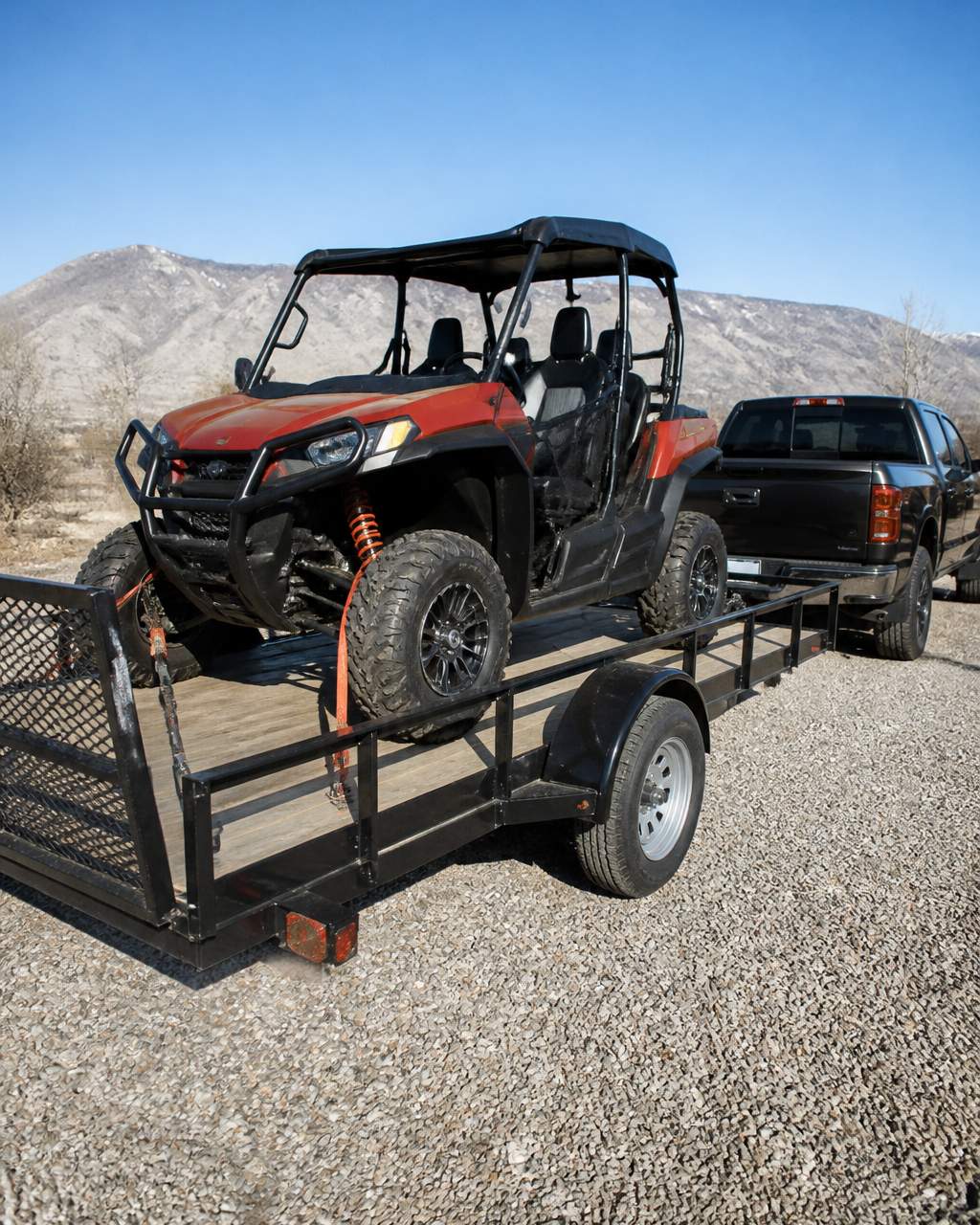
A trailer behaves like a lever. Load forward of the axle pushes down on the hitch, stabilizing the trailer but adding payload to the tow vehicle.
Practical placement for an ATV or UTV:
- Park the machine so the engine sits just forward of the axle.
- Put fuel cans and heavy tools ahead of the machine, not behind it.
- Strap down at four points, and recheck tension after the first few miles.
The Full Towing System: Truck, Hitch, Receiver, and Trailer
The trailer is one link in a chain, and the chain's limit is the weakest link. A trailer rated for 3,000 pounds hitched to a receiver rated for 2,000 pounds is a 2,000-pound system, no matter what the trailer label says.
Every component carries its own rating:
- Tow vehicle: gross combined weight rating and tongue weight limit, both in the owner's manual.
- Hitch and ball: the ball's stamped rating must meet or exceed the trailer's loaded weight.
- Receiver: class rating determines the maximum trailer weight and tongue weight.
Once the system is matched, a step-by-step guide to towing a trailer with an ATV covers the connection, walk-around check, and first-mile inspection in order.
Overloading Symptoms and What to Do When You're Over the Limit
An overloaded trailer tells you before it fails.
If any appear, stop and redistribute the load. If total weight exceeds the trailer's GVWR, the only fix is removing cargo or moving it to a second trailer.
Braking deserves its own note. Many states require trailer brakes above a certain weight threshold, and those thresholds vary by state. Check the American Association of Motor Vehicle Administrators guidance and the state motor vehicle department for the rules that apply before towing a heavy load.
Checking Trailer Ratings at Monarch Honda Before You Tow
Verification beats assumption, and it starts with three pieces of paper and one metal plate. The trailer's certification label, the axle and tire markings, and the tow vehicle's door-jamb sticker together tell you whether the system is matched. Most overload problems start with a number nobody checked.
Read the Certification Label Line by Line
The certification label, sometimes called the VIN data plate, is usually riveted to the tongue or left front frame rail and is required on trailers sold for highway use. It contains:
- VIN: the 17-character vehicle identification number, used to confirm model year and order correct replacement parts.
- GVWR: the maximum total weight of the trailer plus cargo.
- GAWR: the gross axle weight rating for each axle.
If the label is damaged or missing, do not guess. A trailer without a readable certification label is unrated for practical purposes, and the manufacturer or a state inspection station can help you replace it.
Cross-Check the Components
The label gives the manufacturer's rating, but the components tell you whether the trailer still matches it after years of use. Check these in order:
- Axle: a 3,500-pound axle under a 2,990-pound GVWR trailer is normal; a 2,000-pound axle under the same label means it was swapped and the label no longer reflects the build.
- Tires: two tires rated at 1,760 pounds each support 3,520 pounds, so a 2,990-pound GVWR stays within the tire limit. Mismatched tires or a lower load range reduces the real ceiling.
- Coupler: a coupler rated lower than the loaded trailer weight becomes the real limit.
- Safety chains and breakaway cable: check the stamped rating and condition of the links.
The lowest-rated component sets the practical limit. If the label says 2,990 pounds GVWR but the tires are rated for 2,800 pounds combined, treat 2,800 as your ceiling until you replace the tires.
Confirm the Tow Vehicle and Hitch
The tow vehicle's owner's manual lists the gross combined weight rating (GCWR) and tongue weight limit. The receiver hitch carries a class rating determining maximum trailer weight and tongue weight, and the ball must be stamped with a rating that meets or exceeds the loaded trailer weight.
Write down trailer GVWR, receiver rating, and tow vehicle GCWR, and compare them before you hitch up.
Bring the Paperwork to the Dealership
Monarch Honda is an authorized Honda Powersports dealership. Bring the trailer label, the ATV manual, and the tow vehicle's door-jamb sticker.
The takeaway: find the GVWR, subtract the empty weight, weigh everything that goes on the trailer, and confirm the tow vehicle and hitch can handle the total. Whichever number is smallest wins.
Frequently Asked Questions
How much weight can I put on a single axle utility trailer?
It depends on the axle rating, not the trailer's overall size. A typical single-axle utility trailer has an axle rated between 2,000 and 3,500 pounds. Subtract the trailer's empty weight from the GVWR to get usable payload. A 3,500-pound GVWR trailer that weighs 700 pounds empty leaves roughly 2,800 pounds for your ATV, fuel, and gear. Always check the sticker on the trailer frame and the axle tag before loading.
How do I calculate the payload capacity of an ATV utility trailer?
Find the GVWR on the trailer's certification label, then subtract the empty trailer weight. That difference is your payload. From there, subtract the weight of everything you add: the ATV, fuel, coolers, tools, and tie-downs. If the result is negative or close to zero, the load is too heavy. Weighing the loaded trailer at a public scale confirms your math and catches errors the label alone won't reveal.
Does trailer tongue weight count toward an ATV's towing capacity?
Yes. Tongue weight is part of the total load the towing vehicle carries. It counts against the tow vehicle's payload and its hitch's tongue weight rating, not the ATV's capacity. For a typical utility trailer, aim for 10 to 15 percent of the loaded trailer weight on the tongue. Too little causes sway; too much lifts the front tires and reduces steering control.
How should I distribute weight on an ATV utility trailer?
Place the heaviest items over or slightly ahead of the trailer axle, roughly a 60/40 split with more weight forward. Load the ATV facing forward and center it side to side. Keep fuel cans and heavy gear low and ahead of the axle, not behind it. A rear-heavy trailer sways at speed and is harder to control, especially on downhill grades or in crosswinds.
Can an ATV tow a loaded utility trailer safely?
It can, within limits. Check the ATV manufacturer's rated towing capacity, which is usually far lower than a pickup's. Stay well under that number, keep speed down, and allow extra stopping distance. If your trailer and load approach the ATV's limit, reduce the load or use a larger tow vehicle.