 how-to
7 Steps to Transport a Motorcycle in a Pickup Truck
Last Updated: October 25, 2026
Quick Summary
To transport a motorcycle in a pickup truck, confirm the bike fits the bed and the payload rating covers the load, then load it up a ramp and secure it with four ratchet straps, two at the front and two at the rear. Successful motorcycle transport also means compressing the forks only 1 to 2 inches and re-checking every strap after the first few miles.
- Measure bed length from bulkhead to closed tailgate, plus width between the wheel wells and door-jamb payload.
- Most full-size bikes weigh 180 to 350 kilograms, so bed length is usually the limit, not payload.
- Aim for a ramp slope no steeper than about 15 degrees, since tailgates sit roughly 85 to 95 centimeters high.
- Use 1-inch or 2-inch ratchet straps rated for at least 1,000 lb working load, with soft ties on paint and chrome.
- In a short bed, load diagonally, add a wheel chock, and keep the tailgate closed when possible.
Table of Contents
- Motorcycle Transport Basics: Truck Bed Fit and Weight Limits
- Picking the Right Motorcycle Loading Ramp for a Pickup Truck
- How Many Straps to Tie Down a Motorcycle: Strap Count and Anchor Points
- Transporting a Motorcycle in a Short Bed Truck: What Changes
- Loading and Unloading Your Motorcycle Without Damage
- Your Motorcycle Transport Checklist Before the First Mile
- Schedule a Pre-Trip Inspection at Monarch Honda
- Frequently Asked Questions
Motorcycle Transport Basics: Truck Bed Fit and Weight Limits
Learning how to transport a motorcycle in a pickup truck starts with one hard truth: the bike has to fit, and the truck has to carry it. Get those two numbers wrong and no amount of careful strapping will save the trip.
Motorcycle transport is the practice of moving a bike from one place to another without riding it, using a truck bed, trailer, or professional carrier.
Measure Bed Length, Width, and Payload Before You Load
Three measurements decide whether a bike belongs in your truck.
- Bed length: Measure from the bulkhead to the tailgate with the gate closed. A short bed often runs around 1.5 meters, while a standard bed adds roughly 30 centimeters.
- Bed width: Check the space between the wheel wells. A wide bike may not sit flat between them.
- Payload: Find the sticker on the driver's door jamb. Subtract the weight of passengers, gear, and the ramp from that number.
Most full-size bikes weigh between 180 and 350 kilograms, so payload is rarely the limit on a half-ton truck. Bed length usually is. A bike loaded diagonally fits a shorter bed, but the front wheel still needs to contact the bulkhead or a wheel chock.
Picking the Right Motorcycle Loading Ramp for a Pickup Truck
A motorcycle loading ramp for pickup truck use should match the bed height, the bike's weight, and how you plan to store it.
Ramp choice comes down to three factors:
- Length: A longer ramp lowers the angle. Aim for a slope no steeper than about 15 degrees.
- Capacity: Buy a ramp rated well above the bike's wet weight, including fuel.
- Width and surface: Look for a ramp wide enough for both feet and a textured surface for wet boots.
Folding aluminum ramps are the common pick for one rider loading alone. A tri-fold design gives a wider walking surface. Watch out: a ramp rated for a rider plus bike can still flex if the bed height is high and the ramp is short.
How Many Straps to Tie Down a Motorcycle: Strap Count and Anchor Points
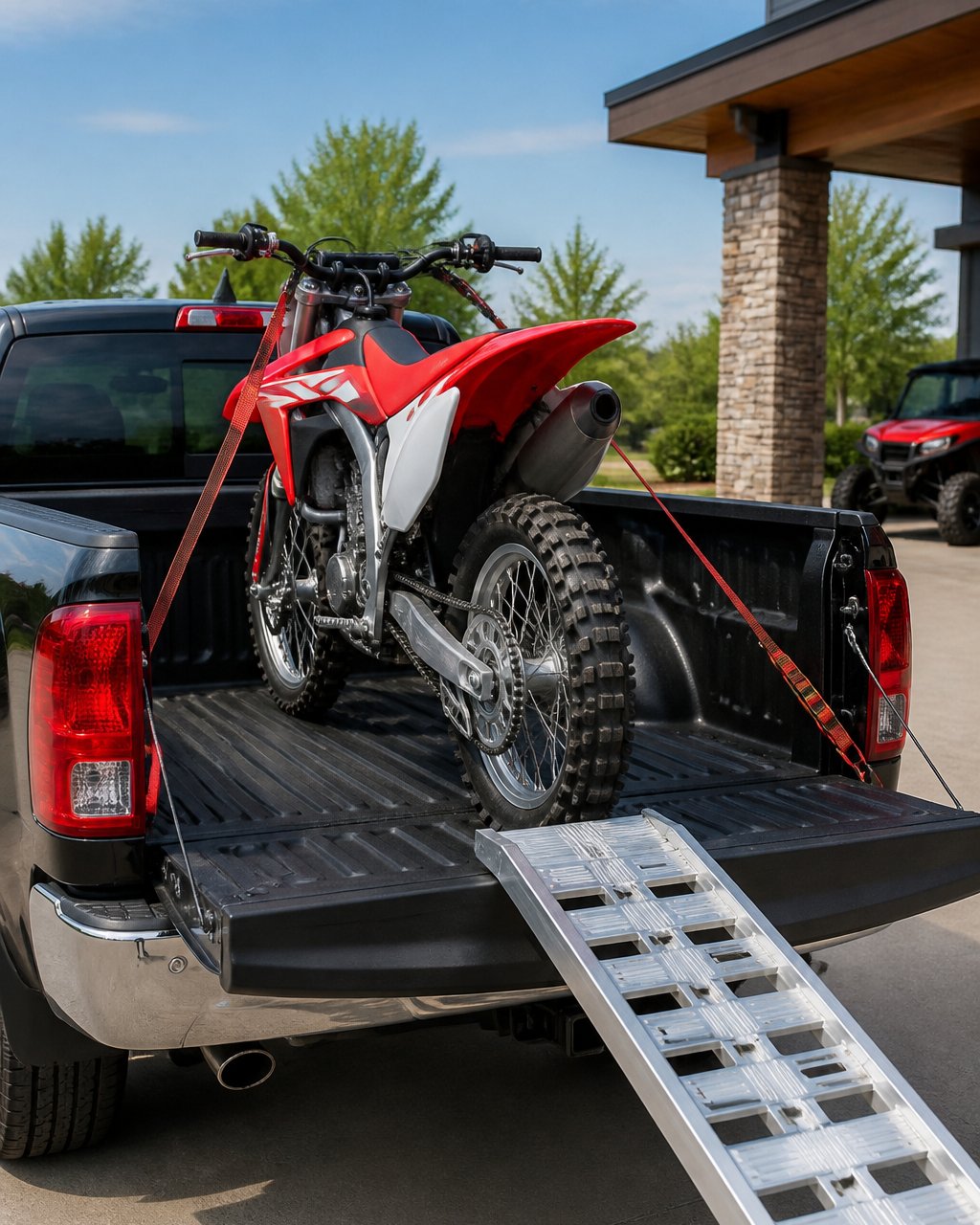
The short answer on how many straps to tie down a motorcycle is four: two at the front and two at the rear. Four quality ratchet straps handle most bikes.
Strap count is only half the job. Where the straps attach and how they pull determines whether the bike stays put at 70 mph or walks sideways in the bed.
Front Strap Geometry
Run the front straps from the handlebars or the triple clamp down and outward to the front corners of the bed. The goal is a wide V shape, not a straight pull. A wide V resists side-to-side movement; a narrow V lets the front wheel pivot.
- Attachment point: Use a soft tie loop around the handlebar or triple clamp, then hook the ratchet strap to the soft tie. Hooking a metal hook directly to a painted bar or a brake line is how riders scratch bars and crush lines.
- Compression target: Compress the forks roughly 1 to 2 inches, or about 25 to 50 mm. That is enough preload to keep the front wheel planted without bottoming the seals. A common mistake is cranking until the fork is nearly flat; that can damage seals and leave the bike with no suspension travel to absorb road input.
- Angle: Aim for roughly a 45-degree angle from the attachment point down to the bed anchor. A steeper angle pulls the bike forward into the bulkhead; a shallower angle pulls it sideways.
Rear Strap Geometry
Run the rear straps from the rear frame or passenger peg mounts outward to the rear corners of the bed. The rear straps do not need heavy compression; their job is to stop the rear wheel from walking.
- Attachment point: Use the frame or a passenger peg mount, not the exhaust, not the swingarm, and not a plastic body panel. Soft ties protect painted surfaces.
- Angle: Pull slightly rearward and outward so the rear of the bike is held against the forward pull of the front straps. The front and rear straps should oppose each other, not pull in the same direction.
Hardware That Matters
- Ratchet straps: Use 1-inch or 2-inch ratchet straps rated for at least 1,000 lb working load. A 1-inch strap is enough for a dirt bike; a 2-inch strap is the safer pick for a touring bike.
- Soft ties: Use soft ties or strap sleeves anywhere a strap contacts paint, chrome, or a brake line.
- Hooks: Closed hooks or flat hooks with a retention clip are less likely to pop off a bed anchor than an open hook. If your bed has no dedicated anchors, add bolt-on D-rings rather than hooking to the bed rail lip.
Post-Load Checks
Check every strap after the first few miles, then again at each stop. Straps stretch, hooks settle, and a bike that felt tight in the driveway can loosen on the first highway expansion joint. A quick walk-around at every fuel stop is the cheapest insurance on the trip.
Here are the strap counts and hardware specs the article recommends for securing a bike in the bed.
| Item | Value | Note |
|---|---|---|
| Minimum straps | Four | Two front, two rear |
| Heavy touring or long haul | Five or six straps | Add for short beds too |
| Fork compression | 1 to 2 inches (25 to 50 mm) | Do not bottom the forks |
| Front strap angle | Roughly 45 degrees | Wide V shape, not straight pull |
| Ratchet strap rating | At least 1,000 lb working load | 1-inch for dirt bikes, 2-inch for touring |
| Strap re-check | After first few miles, then each stop | Straps stretch and hooks settle |
Transporting a Motorcycle in a Short Bed Truck: What Changes
Transporting a motorcycle in a short bed truck demands a different loading angle and a wheel chock. When the bed is shorter than the bike, the rear wheel will hang over the tailgate or sit close to it.
Here is what changes with a short bed:
- Load diagonally: Angle the front wheel into a corner to gain length.
- Use a wheel chock: A bolt-in or removable chock holds the front wheel straight and takes the guesswork out of centering.
- Keep the tailgate closed when possible: A closed gate supports the rear of the bike and keeps the load inside the bed.
A short bed is not a dealbreaker. It just rewards planning before the bike is halfway up the ramp.
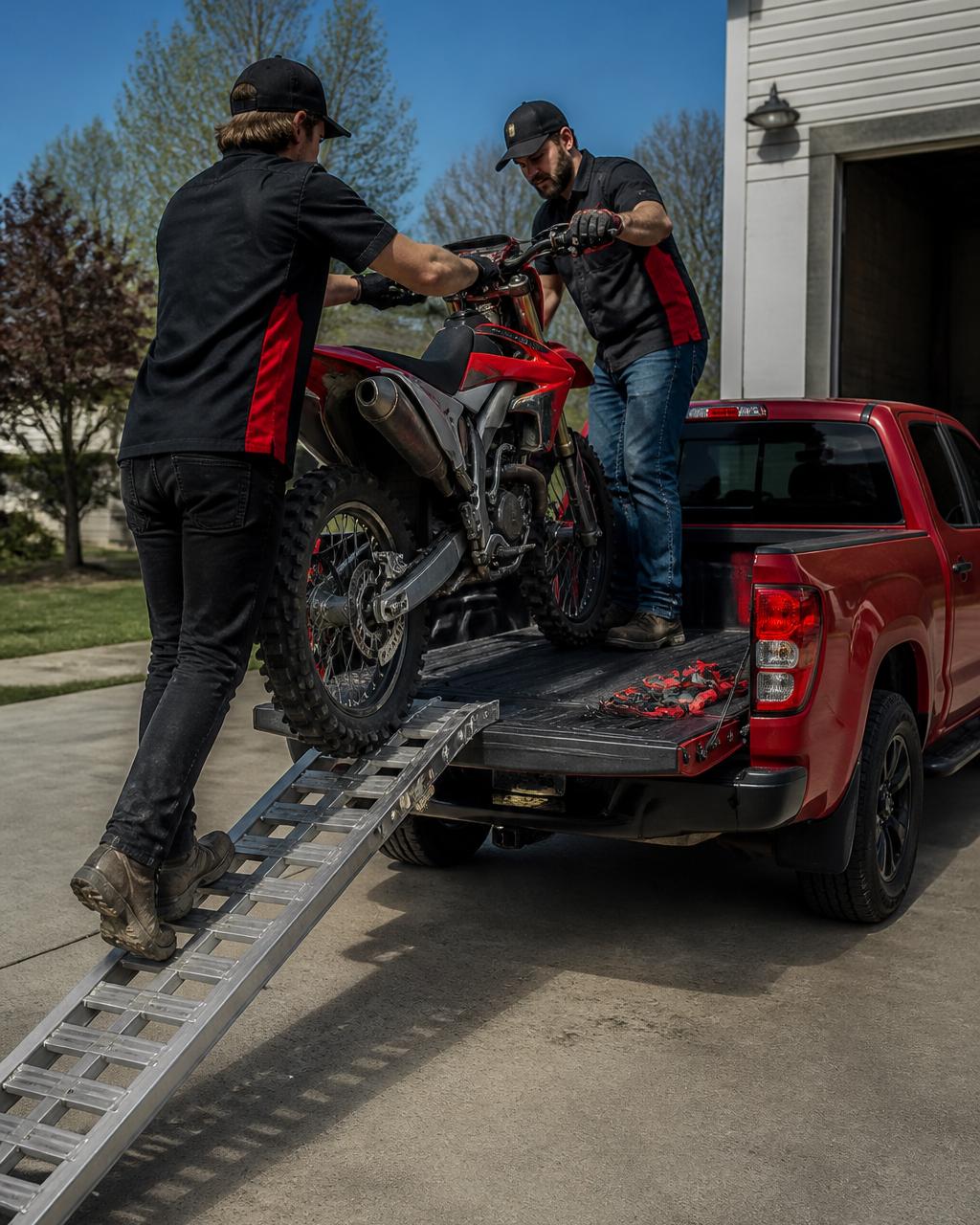
Loading and Unloading Your Motorcycle Without Damage
Loading is where most damage happens, and it usually comes from speed and bad footing. Slow down, use two people when you can, and keep the bike upright.
Follow these steps to load:
- Park on level ground and set the parking brake.
- Set the ramp so the base sits flat and the top hooks securely on the tailgate.
- Start the bike, put it in gear, and walk it up under power with a spotter on the far side.
- Stop when the front wheel hits the bulkhead or chock.
- Shut off the engine and set the bike in gear.
Unloading reverses the process. Keep the bike in gear with the engine off, use the clutch and front brake to control the roll, and let a spotter guide the front wheel down.
Watch out: a wet or sandy ramp is the top cause of a dropped bike. Clean the ramp and wear boots with grip before you start.
Your Motorcycle Transport Checklist Before the First Mile
A motorcycle transport checklist keeps small oversights from becoming roadside problems. The unique angle here is to treat the checklist as a verification workflow, not a shopping list: confirm the load math, confirm the ramp setup, confirm the tie-downs, then confirm the load again after the first few miles.
Step 1: Confirm the Load Math
- Payload: Find the tire and loading information sticker on the driver's door jamb. Subtract the weight of passengers, gear, the ramp, and the bike's wet weight (fuel included). Most full-size bikes weigh between 180 and 350 kg, so payload is rarely the limit on a half-ton truck, but a short bed plus a heavy touring bike plus two passengers can get close.
- Bed length: Measure from the bulkhead to the tailgate with the gate closed. If the bike is longer than the bed, plan a diagonal load and a wheel chock before you start.
- Ramp angle: A tailgate sits roughly 85 to 95 cm off the ground on most stock pickups. A longer ramp lowers the angle; aim for a slope no steeper than about 15 degrees.
Step 2: Confirm the Ramp Setup
- Ramp base sits flat on the ground, not on gravel or a slope.
- Ramp top hooks securely on the tailgate or bed edge.
- Ramp surface is clean and dry; wet or sandy ramps are the top cause of a dropped bike.
Step 3: Confirm the Bike Is Ready to Load
- Fuel level low enough to reduce weight, high enough to start the bike on arrival.
- Tire pressure checked on truck and bike.
- Mirrors and loose accessories folded or removed.
Step 4: Confirm the Tie-Down
- Four straps minimum: two front, two rear.
- Front forks compressed roughly 1 to 2 inches, not bottomed.
- All hooks closed or clipped.
Step 5: Confirm the Load After the First Few Miles
- Re-check every strap after the first few miles.
- Re-check again at each fuel stop.
- Look for strap stretch, hook settling, and any sign the bike has shifted.
Step 6: Confirm the Truck Is Ready
- Ramp stored and secured in the bed.
- Tailgate closed and latched.
- Photo of the bike taken before departure.
If the bike is new to you, review how to buy a used motorcycle safely before hauling it home, and check beginner motorcycle maintenance tips so the bike is road-ready after it comes off the truck.
Schedule a Pre-Trip Inspection at Monarch Honda
A pre-trip inspection catches the worn strap, the soft tire, or the loose battery bolt before a long haul turns into a repair bill. Monarch Honda has served riders for 50 years as an authorized Honda Powersports dealership, and the in-house service team can check tires, brakes, and tie-down points before a trip.
Before hauling a bike, confirm the truck's payload rating, match the ramp to the bed height, and use at least four straps on solid anchor points. A short bed needs a wheel chock and a diagonal load. A slow, two-person load protects the bike better than any single piece of gear. Riders who want a hand with setup can visit Monarch Honda to talk through transport and service needs.
Frequently Asked Questions
How many tie-down straps do you need to haul a motorcycle?
Four straps is the practical minimum: two pulling forward and down at the handlebars, and two pulling rearward from the back of the frame or swingarm to stop the bike rolling backward. Add a fifth strap over the rear wheel if you are hauling on rough roads or a long highway run. Check every strap after the first 10 to 15 miles, since nylon stretches and knots settle once the bike starts moving.
Can you transport a motorcycle in a short-bed pickup?
Yes, but the tailgate usually has to stay down. A full-size bike runs roughly 7 feet long, so a 5.5 to 6.5 foot bed cannot hold it with the gate closed. Load the front wheel against the bulkhead, strap the bike down as normal, and secure the rear wheel so it cannot shift on the open gate. Check that your straps and any flag or marker meet state rules for loads extending past the rear of the vehicle.
Can you lay a motorcycle down in a pickup truck?
Laying a bike on its side is a last resort for short trips in a truck that is too small otherwise. It risks fuel and oil leaking, scratching the bodywork, and bending levers or mirrors. Upright with four straps is the standard method for motorcycle transport. If you must lay it down, drain the fuel first, protect the contact side with a moving blanket, and strap the bike so it cannot slide.
What do you need to transport a motorcycle in a pickup truck?
At minimum: a ramp rated for the bike's weight, four ratchet or cam straps with soft ties, wheel chocks or a front wheel stabilizer, and a helper for loading. Add gloves, a moving blanket, and a tire gauge to your motorcycle transport checklist. Confirm your truck's payload rating covers the bike's wet weight plus rider and gear, and check the tie-down points on the bed floor before you leave.