 how-to
How to Tow a Trailer with an ATV: Step-by-Step
Table of Contents
- Before You Tow: What Your ATV Can Handle
- Picking the Best Trailer for an ATV
- How to Attach a Trailer to an ATV
- How to Load an ATV Trailer for Balanced Towing
- How to Tow a Trailer with an ATV on Trails and Roads
- Common Mistakes When You Tow a Trailer with an ATV
- Conclusion
- Frequently Asked Questions
Last Updated: October 13, 2026
Before You Tow: What Your ATV Can Handle
Learning how to tow a trailer with an ATV starts with one number: your machine's towing capacity. This guide walks through the full process, from checking the owner's manual to hitching up and driving safely.
Every ATV has a limit. Exceed it and you risk clutch damage, brake failure, or a flipped machine on a slope. The good news is that finding your limit takes about five minutes.
Find Your ATV Towing Capacity in the Owner's Manual
The owner's manual is the only source that matters for your specific machine. Look for a section called "Towing" or "Specifications." It lists the towing capacity in pounds.
A common mistake is trusting a dealer's verbal estimate or a forum post. Honda and other makers publish exact ratings for each model, and they vary widely. A small youth ATV may have no tow rating at all. A utility model can pull well over half a ton.
Check these numbers in the manual:
- Towing capacity (total trailer weight)
- Tongue weight limit (downward force on the hitch)
- Gross vehicle weight rating (GVWR)
- Gross axle weight rating (GAWR) for the rear axle
- Front and rear rack capacity
- Curb weight (the ATV with a full tank, no rider or cargo)
Write them down. You will need them in the next step.
Calculate Combined Weight, Payload, and Tongue Weight
Here is the math, step by step:
- Weigh the empty trailer, or use the manufacturer's stated weight.
- Add the weight of your cargo (firewood, tools, game, feed).
- Add the weight of any rider gear carried on the trailer.
- The total must stay under your ATV's towing capacity.
Then check tongue weight. If your loaded trailer weighs 400 pounds, aim for roughly 40 pounds on the tongue. Too little and the trailer sways. Too much and the front wheels get light, which hurts steering and braking.
Finally, reconcile payload. Suppose your ATV has a 600-pound curb weight and a 900-pound GVWR. That leaves 300 pounds of payload.
A worked example with real numbers:
| Item | Weight |
|---|---|
| Empty utility trailer | 150 lb |
| Firewood on trailer | 250 lb |
| Total trailer weight | 400 lb |
| Target tongue weight (10%) | 40 lb |
| Rider | 180 lb |
| Rack cargo | 60 lb |
| Total payload on ATV | 280 lb |
If your GVWR minus curb weight is less than 280 pounds, you are overloaded even though the trailer itself is under the towing capacity. That is the trap: towing capacity and payload are two separate ceilings, and you must clear both.
Picking the Best Trailer for an ATV
The best trailer for an ATV is a single-axle utility trailer sized to your machine's rating, not the biggest one you can find. Match the trailer to the job.
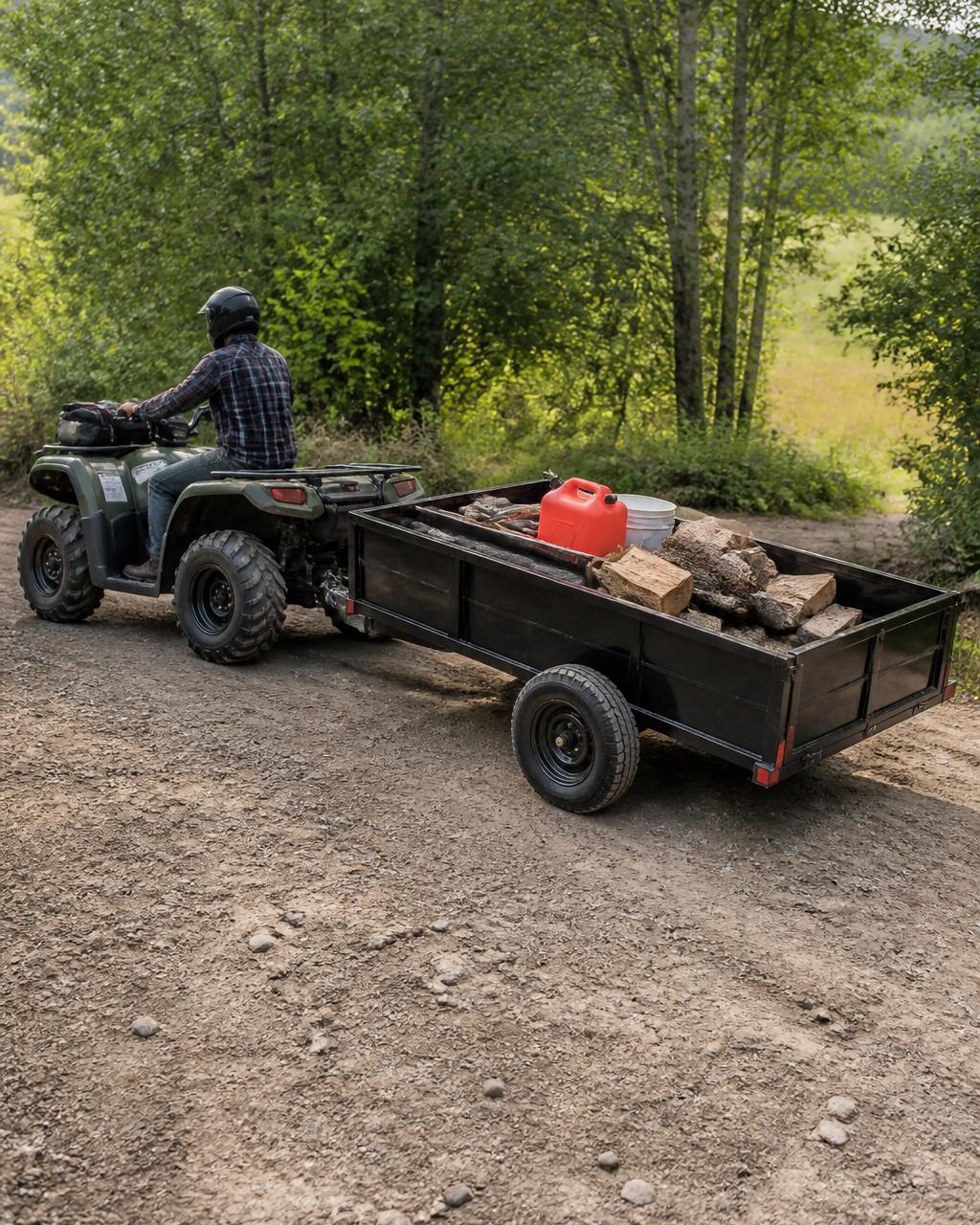
Small utility trailers work for most tasks. They haul firewood, garden supplies, hunting gear, and fencing materials. Look for these features:
- A weight rating below your ATV's towing capacity
- A coupler that matches your hitch ball size
- Lights and reflectors for any road use
- A low bed height for easier loading
Avoid oversized trailers. A trailer built for a pickup truck will overwhelm a mid-size ATV, especially when loaded.
There is an important distinction here. Towing a utility trailer with an ATV is not the same as hauling an ATV on a road trailer. In the first case, the ATV is the tow vehicle. In the second, a truck or SUV does the pulling. Mixing up the two leads to wrong equipment and unsafe setups.
How to Attach a Trailer to an ATV
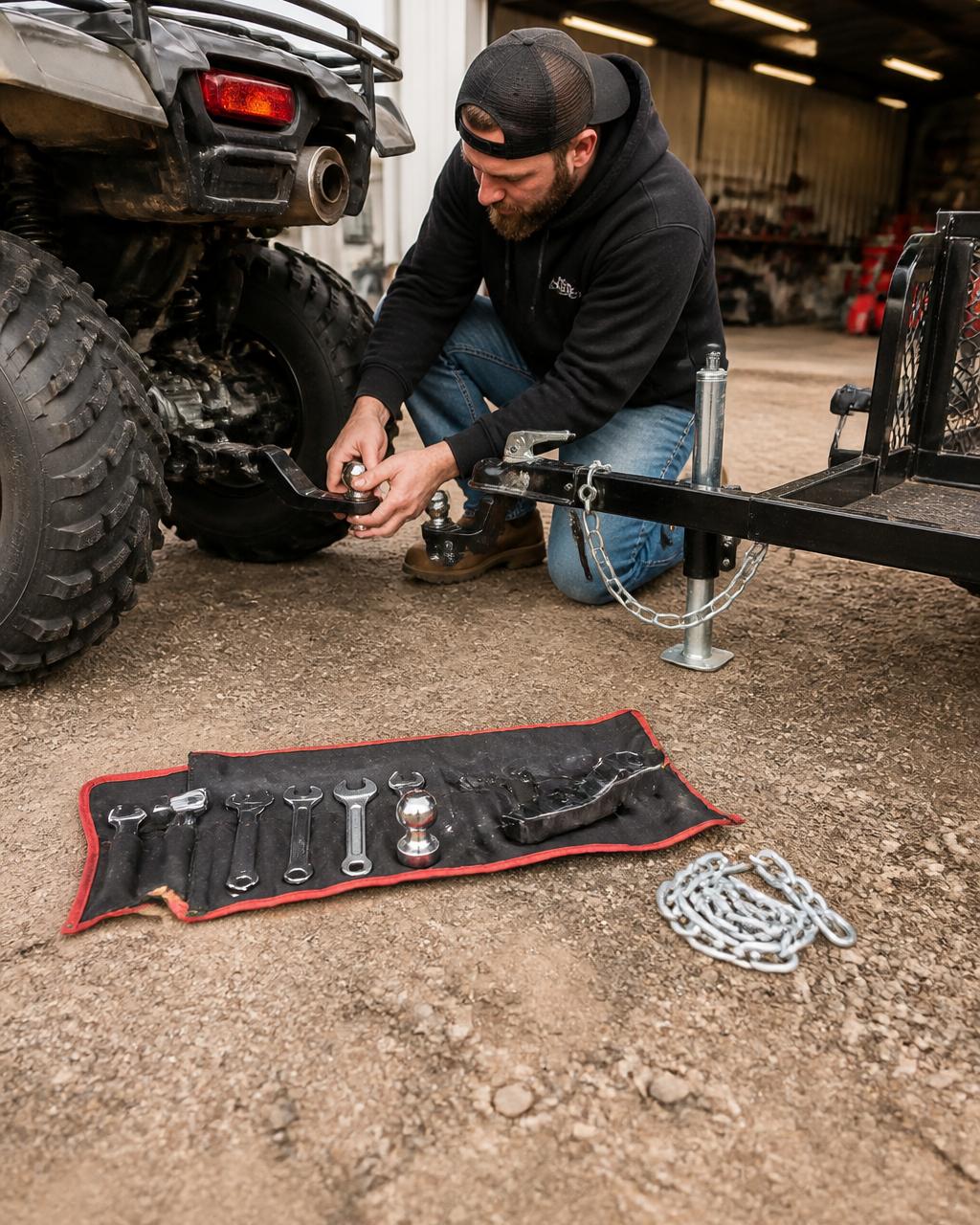
Attaching a trailer safely takes three things: the right hitch, a secure coupler, and a full inspection before you move.
Hitch and Coupler Setup
Most ATVs use a ball hitch mounted on the rear. Some riders add a rigid hitch for heavier, more stable towing. A rigid hitch limits sway better than a ball mount on rough ground.
Follow these steps to attach the trailer:
- Park the ATV on level ground and set the brake.
- Raise the trailer tongue so the coupler sits above the hitch ball.
- Lower the tongue onto the ball until it seats fully.
- Close the coupler latch and lock it.
- Cross the safety chains under the tongue in an X pattern.
- Plug in the trailer lights and test them.
Check the hitch height. The trailer should sit level, or slightly nose-down. A nose-up trailer sways at speed.
Pre-Trip Inspection Checklist
Run this check every single time, even for a short trip:
- Coupler latch closed and pinned
- Safety chains crossed and hooked
- Trailer tires inflated and free of cracks
- Lug nuts tight
- Lights working (brake, turn, tail)
- Cargo tied down with ratchet straps
- Tongue weight within limit
- Hitch ball and mount bolts tight
How to Load an ATV Trailer for Balanced Towing
Loading an ATV trailer is about balance, not just security. Put too much weight behind the axle and the trailer will fishtail. Put too much up front and the ATV's rear suspension sags.
Follow these rules:
- Place heavy items over or slightly ahead of the trailer axle.
- Keep the load centered left to right.
- Use ratchet straps, not rope. Rope stretches and slips.
- Attach straps to the trailer frame, not the side rails.
- Recheck straps after the first few miles.
If you are loading a riding mower or another wheeled item, put it in the same spot every time so you learn the balance point.
How to Tow a Trailer with an ATV on Trails and Roads
Driving with a trailer changes everything about how your ATV handles. It is slower to stop, harder to turn, and less stable on slopes. Adjust your riding to match, and adjust it differently depending on the surface under your tires.
Terrain-Specific Towing
Most guides give one set of driving tips and stop. The surface matters more than the tips.
Mud. Momentum is your friend and your enemy.
Loose gravel. Traction is lower for both the ATV and the trailer tires.
Uneven trails and roots. The trailer tracks inside your ATV's line, so it will clip rocks and roots you cleared.
Side slopes. Avoid them. A trailer on a side hill shifts its weight downhill and can roll the ATV before you feel it coming.
Legal Requirements and Road-Use Limitations
Road legality is where most riders get surprised. Rules are set at the state and local level, and they vary enough that you cannot assume your neighbor's setup is legal for you.
Common requirements to verify before you ride on any public road:
- Whether ATVs are allowed on the road at all, and on which roads
- A driver's license, and in many states a minimum age (often 16) for road operation
- Registration and, in some states, liability insurance
- A slow-moving vehicle emblem and a red taillight visible from a set distance
- Working brake lights and turn signals on the trailer
- A helmet requirement that applies to all riders regardless of age
Public lands add a second layer. Many trail systems ban trailers outright, cap them to certain widths, or restrict them to designated routes. Check the specific land manager's rules, national forest, state park, or private, before you plan a route, not after you arrive at the gate.
Emergency Handling and Recovery
If the trailer starts to sway, do not brake hard. Ease off the throttle and steer straight until it settles. Hard braking makes sway worse.
If a coupler fails or the trailer separates, do not chase it. Slow the ATV under control, then retrieve the trailer.
If you get stuck with a loaded trailer, unhitch and move the trailer first, then free the ATV. Trying to power out with the trailer attached can flip the machine or bend the hitch.
Common Mistakes When You Tow a Trailer with an ATV
The same mistakes show up again and again. Avoid these and most towing problems never happen.
| Mistake | Why It Hurts | Fix |
|---|---|---|
| Guessing towing capacity | Overloads the ATV | Check the owner's manual |
| Skipping the walk-around | Loose coupler or flat tire | Run the checklist every trip |
| Loading weight at the rear | Trailer sways at speed | Move load over the axle |
| Using rope tie-downs | Load shifts and falls | Use ratchet straps |
| Driving at trail speed | No time to stop | Cut speed in half |
| Ignoring tongue weight | Light steering, poor braking | Aim for 10% of trailer weight |
A few more traps to watch for. Young riders should never tow, since the machine responds differently under load. Extended hitches add use that can bend a frame. And a tow dolly is for hauling a vehicle, not for towing behind an ATV, so leave it out of this setup.
Conclusion
Towing with an ATV comes down to respecting the numbers and doing the small checks every time. Know your capacity, balance your load, and drive slower than you think you need to.
For riders near Orem, Monarch Honda stocks ATVs built for real towing work, along with the hitches, straps, and service support to keep them running. The service department can inspect a hitch setup or answer capacity questions before a big haul. A quick stop at Monarch Honda before the season starts saves a lot of trouble on the trail.
Frequently Asked Questions
Can you tow a trailer with an ATV?
Yes, many ATVs can tow a small utility trailer when the load stays within the vehicle's rated towing capacity. Always check your owner's manual for the exact limit, since it varies by model and engine size. Keep the total weight of the trailer and cargo under that number, and use a rigid hitch instead of a flexible one so you keep control on uneven ground.
What is the 80% rule for towing?
The 80% rule means keeping your loaded trailer weight at or below 80% of your ATV's maximum towing capacity. On a machine rated for 850 pounds, that keeps you around 680 pounds loaded. This buffer helps with braking, hill climbs, and rough terrain where traction is limited. It is a safety margin, not a legal requirement, but it reduces strain on the clutch, brakes, and drivetrain.
How do you attach a trailer to an ATV?
Back the ATV up to the trailer, raise the trailer tongue, and lower the coupler onto the hitch ball. Lock the latch, then insert a safety pin or clip so it cannot pop open. Cross the safety chains under the tongue in an X pattern and hook them to the ATV. Connect the trailer lights if it has them, then lift the tongue jack and test that the coupler is locked by pulling forward slightly.
How much tongue weight should an ATV trailer have?
Aim for about 10% of the loaded trailer weight on the tongue. A 500-pound loaded trailer should put roughly 50 pounds of downward force on the hitch. Too little tongue weight causes sway at speed; too much pushes the rear of the ATV down and lightens the front tires, which hurts steering. Load heavier items slightly forward of the axle to hit that target.