 how-to
How to Stop Your ATV Battery From Dying After Storage
Last Updated: November 1, 2026
Quick Summary
Your atv battery keeps dying after storage because of normal self-discharge, a hidden parasitic drain, or sulfation from sitting discharged. Key-off current from clocks and accessories can flatten a healthy battery in weeks, and a discharged battery left to sit hardens lead sulfate crystals and loses capacity permanently.
- A normal key-off draw on most ATVs is under 20 mA; above roughly 50 mA is worth chasing.
- A healthy 12-volt lead-acid battery at 77°F reads about 12.6 volts at rest.
- A battery maintainer stops charging at full and resumes when voltage drops, unlike a trickle charger.
- With the ATV running, a healthy charging system shows about 13.5 to 14.5 volts at idle.
- An ATV battery typically lasts three to five years with regular care, and two to three with neglect.
Table of Contents
- Why Your ATV Battery Keeps Dying After Storage
- Why an ATV Battery Dies While Parked
- How to Test an ATV Battery
- ATV Battery Maintenance During Storage
- How Long Does an ATV Battery Last?
- AGM vs. Lead-Acid vs. Lithium ATV Batteries
- Recovering a Deeply Discharged Battery or Replacing It
- Schedule a Battery Inspection at Monarch Honda
- Frequently Asked Questions
Why Your ATV Battery Keeps Dying After Storage
A dead ATV battery after months in the garage is one of the most common complaints in powersports.
A common scenario: a rider parks a healthy machine in fall, returns in spring, and finds nothing but a click.
Most guides blame the battery, but it's often the victim.
ATV battery self-discharge is the natural loss of charge a battery suffers while sitting idle.
Self-Discharge and Parasitic Drain
Self-discharge happens inside the battery itself. A conventional lead-acid battery loses charge steadily just sitting on a shelf; an AGM holds it longer, and lithium longer still. Warm storage speeds the loss; cold slows it.
Self-discharge is the battery leaking on its own; parasitic drain is the machine sipping from it. Together they can flatten a healthy battery in weeks.
Sulfation: The Silent Battery Killer
Leave a battery discharged long enough and chemistry takes over. Sulfation is the buildup of lead sulfate crystals on the battery plates, and it is the leading reason stored batteries never come back.
A fully charged battery keeps those crystals soft and small; a discharged one lets them harden, and the battery loses capacity, resists recharging, and eventually won't hold a charge.
Here is the part that surprises riders: a battery can read fine on a voltmeter and still be sulfated. Voltage tells you charge level, not capacity.
Why an ATV Battery Dies While Parked
An ATV battery dies while parked because the machine keeps pulling a small current and the battery keeps losing charge on its own.
Cold slows the chemical reaction inside a lead-acid battery, so one that cranks fine in July can feel weak at the first frost.
Age compounds everything. A well-kept battery lifespan runs several seasons; a neglected one can fail in two.
Common drain sources on a parked ATV include:
- Dash clocks and digital displays
- Accessory wiring straight to the battery
- A stuck relay or a failing switch
Loose connections and corrosion on the battery terminals add resistance and can mimic a failing battery.
How to Test an ATV Battery
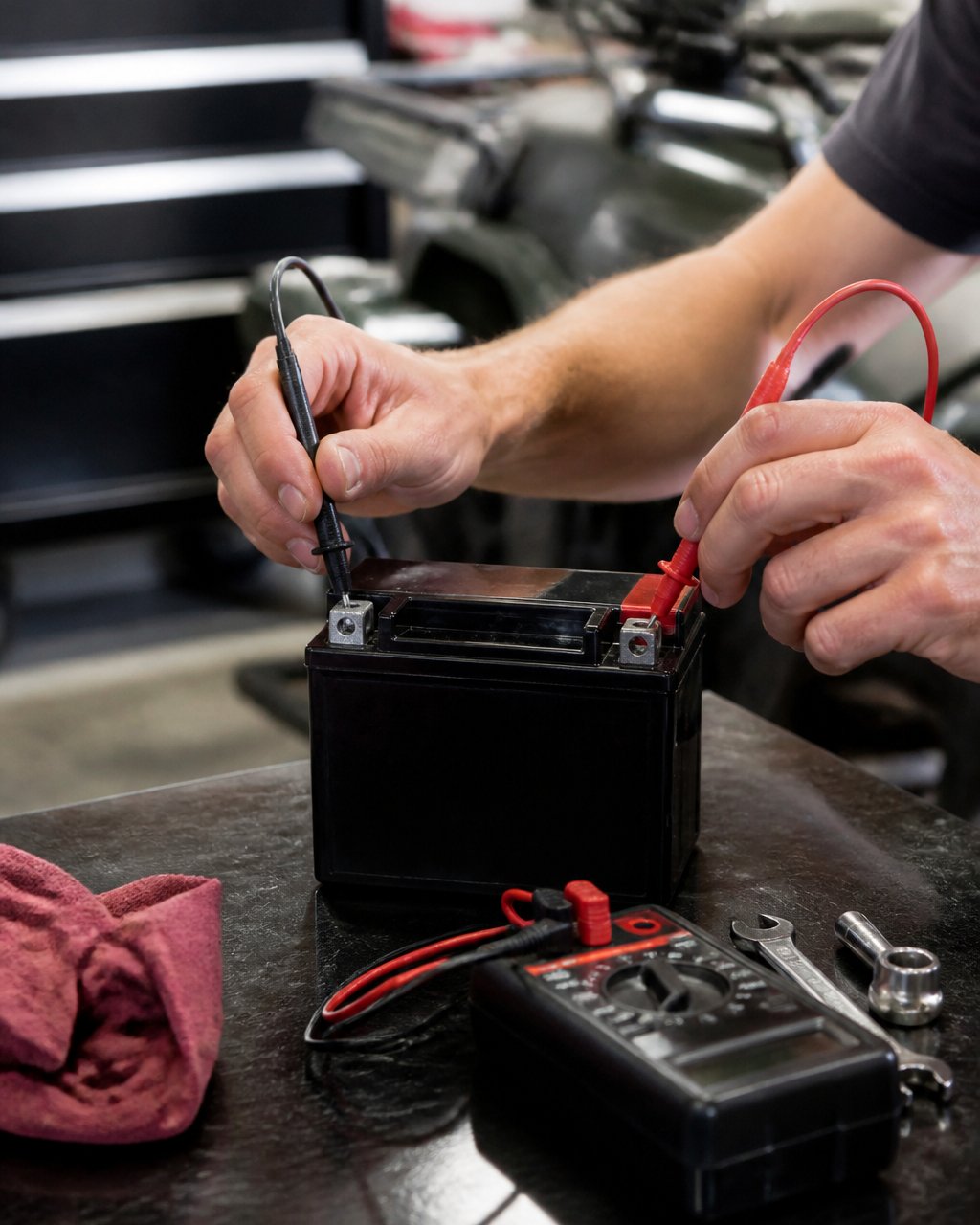
Testing an ATV battery takes a multimeter, about ten minutes, and a little patience. Start with voltage, move to a load test, then check for drain, each test tells you which to run next.
Voltage and Load Testing
A voltage test is the fastest first step. Set the multimeter to DC volts and touch the probes to the battery terminals with the ATV off.
- 12.6 volts or higher: fully charged and healthy
- 12.4 volts: about half charged
- 12.0 volts or lower: discharged and needs attention
Resting voltage should be read after the battery has sat for a few hours, not right after charging, since a fresh charge reads high and tells you nothing.
A load test is the real test.
Isolating Parasitic Drain
If a healthy battery keeps dying, find the draw, the most useful skill in this article. A normal key-off draw on most ATVs is under 20 mA (0.020 amps); anything above roughly 50 mA is worth chasing, and a draw in the hundreds of milliamps will flatten a battery in days.
- Charge the battery fully and let it rest.
- Set the multimeter to DC amps (start on the highest amp range, then step down).
- Disconnect the negative cable and connect the meter in series between the cable and the battery post.
- Read the current with everything off and the key out. Wait a minute or two, some modules go to sleep after a delay.
- Pull fuses one at a time, watching the meter. When the reading drops, you've found the circuit.
- Trace that circuit to the accessory or component causing the short circuit or drain.
Watch out: never crank the engine or turn on accessories with the meter in series, the surge can blow its fuse or damage it. Never test amps across the battery posts directly, which creates a dead short.
While you're in there, check the charging system. With the ATV running, a healthy system shows about 13.5 to 14.5 volts at idle, rising slightly with RPM. If voltage stays low or swings, the stator, voltage regulator, or rectifier may be at fault, a weak charging system leaves the battery undercharged, which looks exactly like a battery that won't hold a charge.
Symptom-Led Decision Tree
Use the results in order. Each branch tells you what to do next instead of replacing parts on a hunch.
- Battery reads below 12.4 volts after a full charge and rest: the battery is the problem. Load test it; if it fails, replace it.
- Battery reads 12.6 volts or higher at rest but the ATV won't crank: load test. A pass means look at cables, terminals, and the starter relay; a fail means replace the battery.
- Battery passes the load test but dies again within days of storage: measure key-off current. Above roughly 50 mA means you have a parasitic drain, go to the fuse-by-fuse procedure.
That sequence separates the three real causes, a bad battery, a parasitic drain, and a charging-system fault, so you fix the actual problem instead of buying a battery every spring.
ATV Battery Maintenance During Storage
Good storage is the difference between a battery that fires up in spring and one that goes to the recycler. The routine is short and worth the effort, but the details change depending on how long the ATV sits and what kind of battery is in it.
Before Storage
- Charge the battery fully with a smart charger, then let it rest and confirm it holds about 12.6 volts.
- Remove it from the ATV, or disconnect the negative cable. Disconnecting alone stops parasitic drain but not self-discharge.
- Clean the terminals and apply a light coat of terminal protectant.
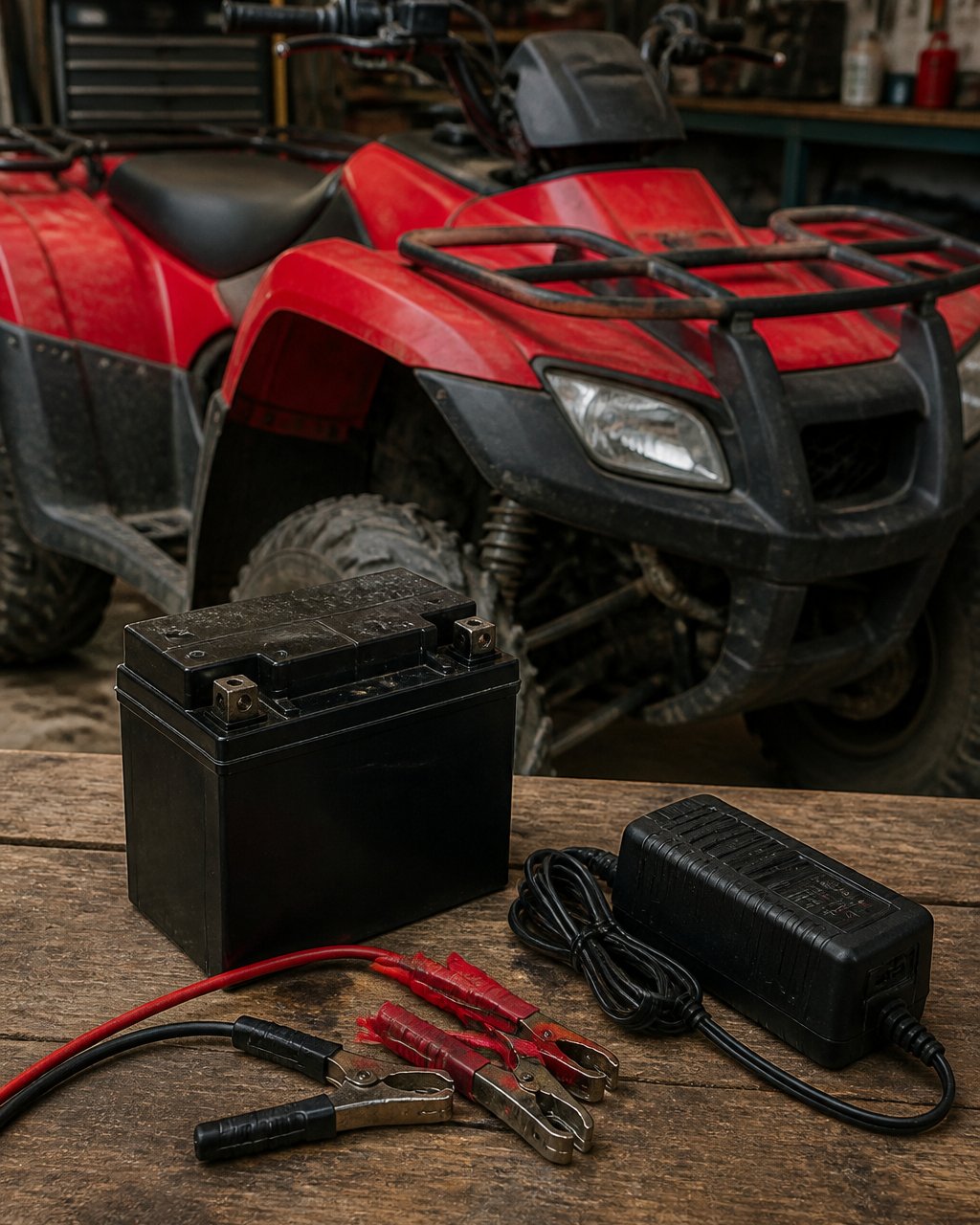
A battery maintainer is the single best investment here: unlike a trickle charger, it stops charging at full and resumes when voltage drops, so it won't overcharge a stored battery. For guidance that covers the rest of the machine, see these motorcycle maintenance tips for beginners.
Riders who leave the battery in the ATV should still disconnect the negative cable and use a maintainer with a quick-connect lead, which handles both self-discharge and parasitic drain.
Month-by-Month Storage Schedule
A calendar keeps a stored battery from quietly dying. This schedule works for conventional lead-acid and AGM batteries; lithium needs its own notes below.
- Month 1: Full charge, disconnect the negative cable or remove the battery, and connect the maintainer. Record resting voltage.
- Month 2: Check that the maintainer is still powered and the leads are tight. Read voltage; it should sit near 12.6 volts or the maintainer's float level.
- Month 3: Read voltage again. If it has dropped below about 12.4 volts with a maintainer connected, the maintainer or the battery is suspect, test both.
Chemistry-Specific Storage Notes
- Conventional lead-acid: self-discharges fastest and may need water checks on serviceable models. Keep it on a maintainer and check electrolyte level before storage if the caps are removable.
- AGM: sealed and holds charge longer. Use an AGM-compatible maintainer; a generic charger can overcharge a sealed battery.
- Lithium: holds charge longest but does not like being charged in freezing temperatures. Charge it above freezing, then store it partially charged per the manufacturer's guidance, and use only a lithium-specific charger.
Bringing the ATV Back Into Service
After months of inactivity, do not just hit the starter and hope.
- Read resting voltage before reconnecting, below 12.4 volts means charge it first.
- Inspect terminals for corrosion and tighten them.
- Start the ATV and read charging voltage, about 13.5 to 14.5 volts is healthy.
- If it cranks weakly or voltage drops hard, run a load test before trusting it on a long ride.
- If it fails the load test after a full charge, replace it rather than nursing it through another season.
That recovery sequence catches the two failure modes storage creates, a sulfated battery and a drain that reappears the moment the machine is back in service, before they strand you on the trail.
How Long Does an ATV Battery Last?
An ATV battery typically lasts three to five years with regular care, and two to three years with neglect. Battery age is the quiet factor most riders overlook.
Capacity fades gradually: a four-year-old battery may still start the ATV in mild weather and fail at the first cold snap.
Storage habits decide which end of that range you land on. A battery kept charged, cool, and disconnected routinely outlasts one left to drain.
AGM vs. Lead-Acid vs. Lithium ATV Batteries
Battery type changes how you store and maintain it, and it changes how much drain the battery can shrug off.
| Battery Type | Self-Discharge | Cold Weather | Care Notes |
|---|---|---|---|
| Conventional lead-acid | Fastest | Weakest | Needs frequent topping off |
| AGM | Slower | Better | Sealed, low maintenance |
| Lithium | Slowest | Needs care | Uses a lithium-specific charger |
An AGM battery is sealed, holds charge longer, and handles vibration and cold better than conventional lead-acid; most modern ATVs ship with one.
A lithium battery holds charge longest and weighs far less, but needs a lithium-specific charger and doesn't like charging in freezing temperatures.
Recovering a Deeply Discharged Battery or Replacing It
A deeply discharged battery can sometimes be recovered, but not always.
If the battery holds voltage and passes a load test, it earned another season.
Watch out: never jump-start a frozen battery or charge one that shows bulging or leaks. Replace it instead. A damaged battery can fail dangerously.
For riders unsure whether a battery is recoverable, a professional battery inspection can help.
Schedule a Battery Inspection at Monarch Honda
Most ATV batteries that die after storage can be saved with a maintainer, a clean connection, and a proper test. The rest need a diagnosis that goes beyond the battery itself.
Monarch Honda is an authorized Honda Powersports dealership in its 50th year, with an in-house service department. Contact Monarch Honda to schedule service, or visit https://www.monarchhonda.com for more information.
Frequently Asked Questions
Should I disconnect my ATV battery during storage?
Yes, disconnecting the negative terminal is a simple way to stop parasitic drain while your ATV sits. Even with the key off, accessories like clocks or security systems can slowly pull power. Disconnecting the battery prevents this. For longer storage, remove the battery entirely and keep it on a trickle charger in a cool, dry place. This also makes it easier to check voltage and clean terminals.
Can cold weather damage an ATV battery during storage?
Cold temperatures slow the chemical reactions inside a battery and reduce its capacity. A fully charged battery can survive freezing conditions, but a discharged one can freeze and crack internally. If you store your ATV in an unheated space, remove the battery and store it indoors on a maintainer. This protects it from extreme cold and keeps it ready for spring.
How can I tell if my ATV battery needs to be replaced?
A resting voltage below 12.4 volts after a full charge, a failed load test, or visible swelling and corrosion are signs it's time for a new battery. If the battery is more than three to five years old and keeps dying despite proper maintenance, replacement is usually the most reliable fix. Have it tested with a load tester or at a service department to confirm.
How do I keep an ATV battery charged over winter?
Use a battery maintainer or trickle charger designed for powersports batteries. These devices deliver a low, safe current to keep the battery at full charge without overcharging. Connect it before storage and check the voltage monthly. If you can't use a maintainer, charge the battery fully every few weeks. Store it in a cool, dry spot away from freezing temperatures.